You don’t need another prompt.
You need four hours
Session one builds the brain that holds your product, your voice, and your judgment. Session two builds your first Play on top of it. Compete, Position, or Launch, running on your real work by the time we’re done. You do the talking. It ends up in your repo, on your computer.





“This feels like a freaking cheat code. This stuff used to take forever and now all I do is type ‘yes’ and enter and it does it all. It’s nuts.”
David Lim, product marketer
Someone told you to use AI. Nobody told you how.
The mandate
“My CMO says use AI. Nobody said how.”
No KPI, no baseline, no definition of done. One PMM called it “eat this pill, we won’t tell you why.”
The search
“I can’t tell what’s worth building.”
You have Claude, budget, permission. What you don’t have is the signal. “All my time watching Claude influencers. Not worth the squeeze.”
The clock
“And the work doesn’t stop.”
You’re not carving out four clean hours. Slack, LinkedIn, the launch, all of it pinging while you try to focus.
Every road you took ends in the same place.
None of these fail because you’re lazy or slow. They fail for the same structural reason, and it’s at the bottom of this list.

“I’ll figure it out from YouTube”
You watch the builders. You save the threads. Months later you still can’t tell which of it was built for a job like yours.

“I’ll just tell Claude what I want”
It reads fine and sounds like everyone else’s, because you described your product to a window that forgets you tomorrow. Then you spend the hour rewriting that you meant to save.

“I’ll take a course”
Forty hours of video built for engineers, on an example product that isn’t yours. Nothing you build in it survives a real launch.
“I’ll hire someone to build it”
Now you own something you can’t open. It breaks the week of a launch, and you’re back in a queue waiting on whoever built it.
Every one starts by forgetting who you are.
01
It doesn’t know you
Every tool asks you to describe your product from scratch, every single time.
02
So it sounds generic
It hands back the median of everything. “AI is still popping out the same baby for everyone.”
03
The fix is boring
Give it your context once, in a place it keeps. Build the memory first, then build what runs on it.
Two sessions. Brain, then Build.
Two hours each, live, one on one, two days in a row. You share your screen and you drive the whole time. Overnight you run it on your own work, and session two opens with whatever broke.
🧠 The Brain
The two hours where your product, your customers, your positioning, your voice, and the way you make calls stop living only in your head.
The part nobody does
You talk, I write it down. How you decide what’s worth acting on and what to ignore, the format you actually want, the words you use and the ones you never use. Skip this and every output sounds generic. This is the step that makes it sound like you.
Your real knowledge, loaded in
Your docs, your past work, your SOPs, whatever you already have. It goes in as the foundation. We start an append-only log so every correction you make from here forward is kept instead of lost.
The first output you’d actually send
We drop two or three real sources in. It produces your format, grounded and sourced. You edit it live, out loud, and we save the edit so the agent has your change on the record. This is the moment the session turns.
You leave with
Your own repo, plus one finished piece running through it. A battle card, a positioning note, a launch brief. Grounded, sourced, reading like you wrote it.
🛠️ The Build
We take one job you do by hand every week and turn it into a Play your brain runs. Then we write down how it works, while you still remember.
The map, before the build
We whiteboard the Play at altitude. Input, process, output. Where a human approves before anything goes out. What breaks if you touch which piece. Ten minutes of drawing that decides whether you can reopen this in six weeks.
Your first Play, on your real work
The job you actually do by hand every week, running on your product, with your data in it, in the format you defined in session one. You drive. Mostly that means you talking, and me telling you where to point it.
The runbook, written while you remember
How to run it Monday. What each piece does. What to check when it acts strange. Ten minutes of writing that buys back the week you’d otherwise lose relearning your own build.
You leave with
Your first Play running on your real work, a runbook, and a map. In your repo, on your computer.
Pick your first Play
A Play is one PMM job your brain runs end to end. You pick one on the intro call and we build that one in session two. Once the brain exists, the second Play is a fraction of the work, and you build it without me.
Compete
A competitor ships something. Your Play pulls the real sources, rebuilds your positioning against them, and hands you a battle card you approve before sales sees it.
Position
Your Play reads your live site, ads, emails, and decks every week, scores them against the positioning you locked in session one, and flags every line that drifted.
Launch
You point your Play at what’s shipping. It writes the brief and the positioning for your ICP, then maps the timeline you can actually run.
The same shape, every time.
Once it’s built, a Play runs on rails. Something kicks it off, your brain does the work in your voice, and it stops at a gate for you to approve before anything leaves the building. You stay in the loop by design.
Something kicks it off
- ◆A competitor ships
- ◆A weekly timer fires
- ◆You drop in sources
Does the work, in your voice
Nothing leaves until you approve or edit it. Every correction is kept.
A battle card, a drift report, a launch brief. Ready to use.
lands in Slack · your repo
All of it. The day we finish.
It sits in your repo, on your computer, under your account. Nothing to renew, nothing to log into, nobody to wait on. It follows you to your next role.
You walk out owning
A CLAUDE.md that holds your product, your ICP, your positioning, your voice, and your judgment. Written with you, in your words.
One working Play, built on your real work, running on your computer.
The append-only log that keeps every correction you make, so it gets more like you instead of less.
A runbook you can open cold in six weeks and understand.
The map of what you built, at altitude, so you can find what broke without reopening everything.
It lives in your repo, on your computer. You own it the day we finish.
14 days of async Slack after the second session, for when it gets weird.
Yours to keep. No retainer, no lock-in.
What changes on the Monday after.
You can answer the AI question with a demo
Next time it comes up in a leadership meeting, you open a laptop and run the thing on real work. That conversation goes differently than the one where you describe a plan.
It stops sounding like everyone else
Because it holds your positioning and your voice, not a generic idea of a product marketer. The first draft reads like something you’d send instead of something you’d rewrite.
You stop losing the thread on your own work
Most people build something that works, come back in six weeks, and can’t remember how it fits together. You leave with the map written, so the thing you built stays usable.
It travels with you
It’s code and context files in your repo, on your computer. It follows you to your next role, your next product, your next team. Nobody can switch it off.
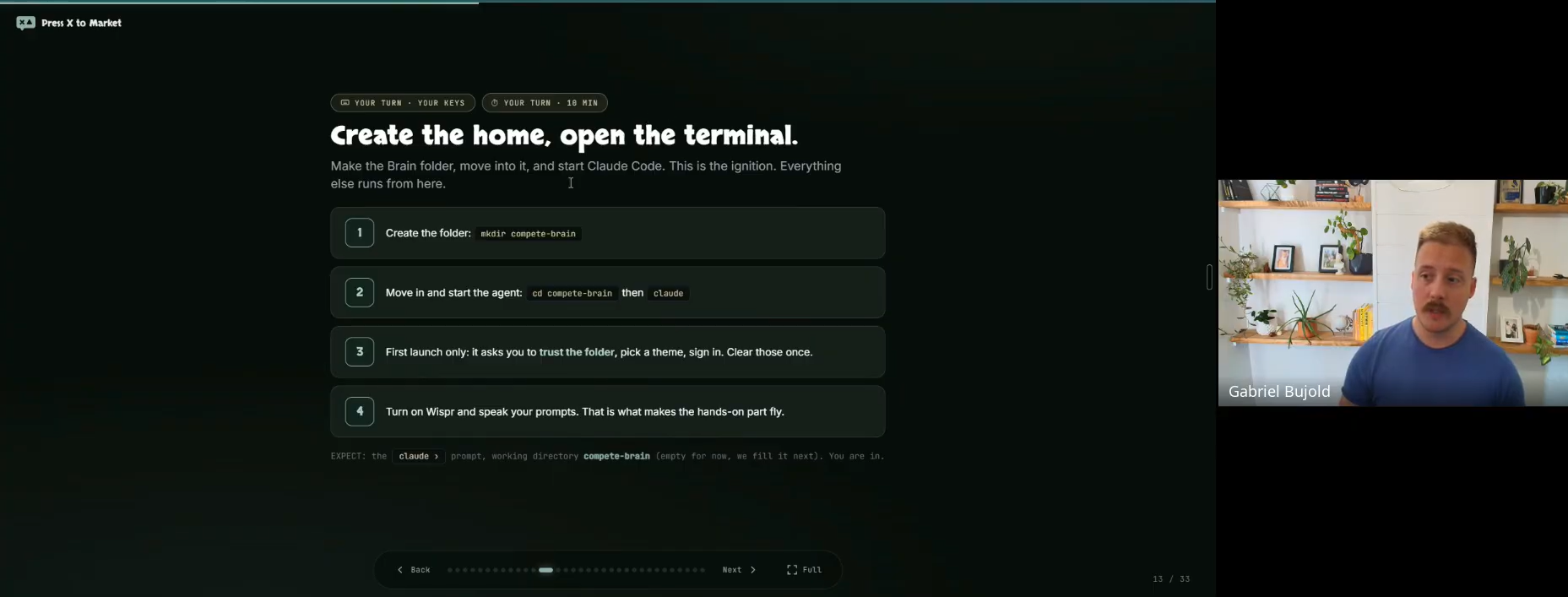
Session one. Opening the terminal, building the Brain.
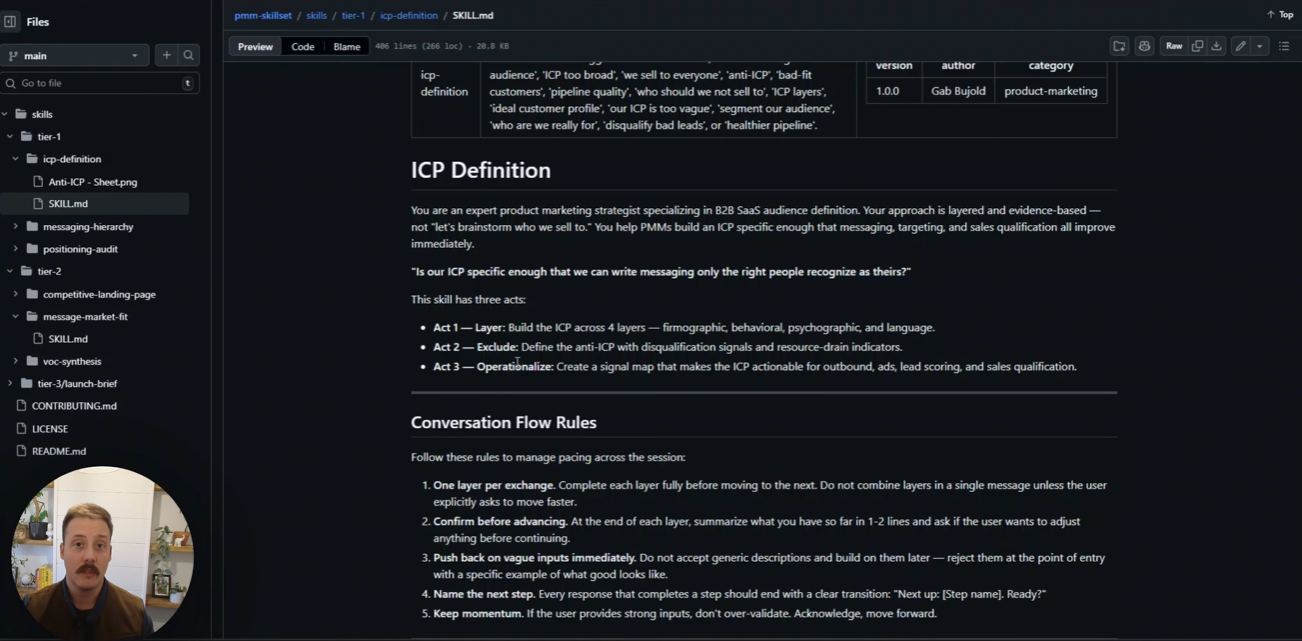
The judgment, written into a skill you own.
What people say after working with me.
Ten years of product marketing, most of it spent on messaging and positioning for B2B SaaS. Top 100 PMM consultant two years running, co-host of We’re Not Marketers, 75 episodes deep. The training exists because that’s the judgment we’re encoding in session one.
Gab’s ability to turn complexity into clarity is astounding. There have been times when a simple workshop of 15-20 minutes brings all the insight I need to write a compelling story. He has proven to be one of the best in B2B messaging. His frameworks and unique discipline for the craft sets him apart.
Eric Holland
Head of Product Marketing
Gab’s groundbreaking approach to scoring message-market fit is just one of the ways he’s helping PMMs elevate the industry. I’d lose my mind without Gab’s gut checks and invaluable feedback.
Michele Nieberding
Director of Product Marketing
Gab’s advice really helped our technical product messaging. His insights on customer pain points, product complexity, and testing through executive conversations were super useful. His approach to testing refined messaging is spot-on. I was unsure how to be effective with our positioning, but now I know how we can differentiate.
Marie Jacksman
Growth marketer
Just tested the launch brief. It saved me hours of work.
Jenny Salem
Product marketer
Gab’s consultation really helped clarify the steps needed to strengthen our positioning and find our point of differentiation. Hearing his ideas brought me out of a rut and gave me a good sense of the direction we need to take.
Ranudi Jayasinghe
Product marketer
Tried the positioning. Got nice results out of it.
Peter Kortvel
Product marketer
Gab’s ability to turn complexity into clarity is astounding. There have been times when a simple workshop of 15-20 minutes brings all the insight I need to write a compelling story. He has proven to be one of the best in B2B messaging. His frameworks and unique discipline for the craft sets him apart.
Eric Holland
Head of Product Marketing
Gab’s groundbreaking approach to scoring message-market fit is just one of the ways he’s helping PMMs elevate the industry. I’d lose my mind without Gab’s gut checks and invaluable feedback.
Michele Nieberding
Director of Product Marketing
Gab’s advice really helped our technical product messaging. His insights on customer pain points, product complexity, and testing through executive conversations were super useful. His approach to testing refined messaging is spot-on. I was unsure how to be effective with our positioning, but now I know how we can differentiate.
Marie Jacksman
Growth marketer
Just tested the launch brief. It saved me hours of work.
Jenny Salem
Product marketer
Gab’s consultation really helped clarify the steps needed to strengthen our positioning and find our point of differentiation. Hearing his ideas brought me out of a rut and gave me a good sense of the direction we need to take.
Ranudi Jayasinghe
Product marketer
Tried the positioning. Got nice results out of it.
Peter Kortvel
Product marketer
And the founders who hired me
With Gabriel’s help, our response rate increased from 7% to 30% in just a few months, opening up many deal opportunities for us.
Justin Roberge
Founder
After working on our messaging and ICP, Gab started owning our social content strategy. Within 2 weeks, I’ve got a 10x impressions boost and my first inbound lead from LinkedIn. Gab’s the GOAT.
Warren Sadler
CEO
I did not know Gabriel, I simply found that his publications made sense. What he publishes is exactly how he works. It is real, simple, relevant, and effective. If you’re tired of Grandpa’s marketing or promises of growth that aren’t based on anything, this is the right guy.
Philippe Libioulle
Founder
I’m not a product marketer, so Gab was helpful in providing direction about WHY the method he was running to answer questions was necessary.
Danny Chu
CEO
From the get-go, Gab came up with a structure and provided us with quality material to help with product messaging. Gab will quickly understand your business, your customers and help you with your value proposition.
Marc-Antoine Dion
CEO
Gab is really knowledgeable and helped us understand potential channels to test our messaging on. If I had to score the 30-minute call we’ve had, it would be 10/10.
Kimon V.
CEO
Working with Gab has been amazing. His knowledge, guidance and help in this process was extremely helpful to guide our organization to success. Plus his smile and moustache came with positive vibes only.
Lee Willoughby
Co-Founder
Gabriel solved a tricky problem with my product messaging. He also helped me focus my copy for my ideal customers. He knows his stuff.
Jonathan Corrales
Founder
With Gabriel’s help, our response rate increased from 7% to 30% in just a few months, opening up many deal opportunities for us.
Justin Roberge
Founder
After working on our messaging and ICP, Gab started owning our social content strategy. Within 2 weeks, I’ve got a 10x impressions boost and my first inbound lead from LinkedIn. Gab’s the GOAT.
Warren Sadler
CEO
I did not know Gabriel, I simply found that his publications made sense. What he publishes is exactly how he works. It is real, simple, relevant, and effective. If you’re tired of Grandpa’s marketing or promises of growth that aren’t based on anything, this is the right guy.
Philippe Libioulle
Founder
I’m not a product marketer, so Gab was helpful in providing direction about WHY the method he was running to answer questions was necessary.
Danny Chu
CEO
From the get-go, Gab came up with a structure and provided us with quality material to help with product messaging. Gab will quickly understand your business, your customers and help you with your value proposition.
Marc-Antoine Dion
CEO
Gab is really knowledgeable and helped us understand potential channels to test our messaging on. If I had to score the 30-minute call we’ve had, it would be 10/10.
Kimon V.
CEO
Working with Gab has been amazing. His knowledge, guidance and help in this process was extremely helpful to guide our organization to success. Plus his smile and moustache came with positive vibes only.
Lee Willoughby
Co-Founder
Gabriel solved a tricky problem with my product messaging. He also helped me focus my copy for my ideal customers. He knows his stuff.
Jonathan Corrales
Founder
The training
2 sessions · 4 hours · you own everything we build
Two days in a row, four hours total, and you own everything we build.
20 minutes. I’ll tell you if it’s not a fit.
Want it built for you instead? See the Sprint →
If you’re serious about AI, this one’s for you.
It asks something of you. You do the building, you do the thinking, and you leave owning it. That rules some people out, and it should.
Book it if
- ✓
You’re a product marketer, solo or leading a small team, at a B2B SaaS company.
- ✓
Someone above you has said the word AI in a meeting and nobody defined what done looks like.
- ✓
You’ve opened Claude or ChatGPT, gotten something mediocre, and quietly stopped using it for the work that matters.
- ✓
You want to build it yourself and own it, with someone next to you the first time.
- ✓
Your security team is tight about what tools get in, and a thing you build on your own machine is an easier conversation than a vendor.
- ✓
You have four hours and one real piece of work to point this at.
Skip it if
- ×
You want it built for you. That’s the Sprint, and it’s a different page.
- ×
You’re already fully inside Claude Code with your own skills and hooks. You don’t need me, you need a peer.
- ×
You can’t get a paid Claude plan approved. Claude Code won’t sign in without one, and that will end the session in the first ten minutes.
- ×
You want to watch. You’ll be the one typing the whole time.
- ×
You’re looking for the prompt that fixes it. There isn’t one, and that’s the entire reason this takes four hours.
Training FAQ
The things people ask before booking.
Q Do I need to know how to code? +
Q Why two sessions instead of one afternoon? +
Q Can I just do session one? +
Q What do I need before we start? +
Q Will my security team let me do this? +
Q What happens after the second session? +
Q How is this different from the Sprint? +
You’re four hours from a brain and your first Play.
Book 20 minutes. Tell me the job you’d point this at. If it’s a fit, we’ll put the two sessions on the calendar. If it isn’t, I’ll say so and point you somewhere better.
Not ready? Install a free skill first →